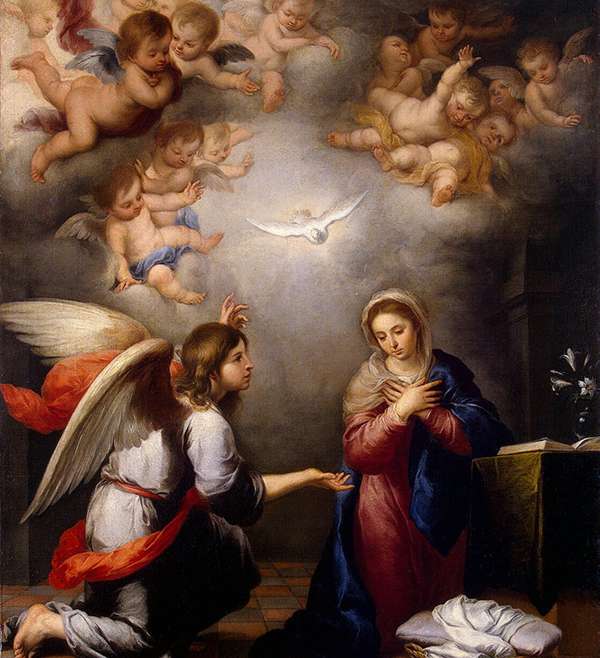
“The Immaculate Conception was preparation for the Annunciation,
and the Assumption was the consequence of the Annunciation.
Even Christ’s birth at Christmas was a result of the Annunciation.”
By Fr. Jim McCormack, MIC
The Solemnity of the Annunciation of the Lord, which we celebrate on 25 March, may, at first glance, not seem as significant as other Marian feasts. After all, it’s not one of the holy days of obligation, such as the Immaculate Conception (8 December) or the Assumption of Our Lady (15 August). Yet, in a sense, its significance overshadows all other feasts, except Easter.
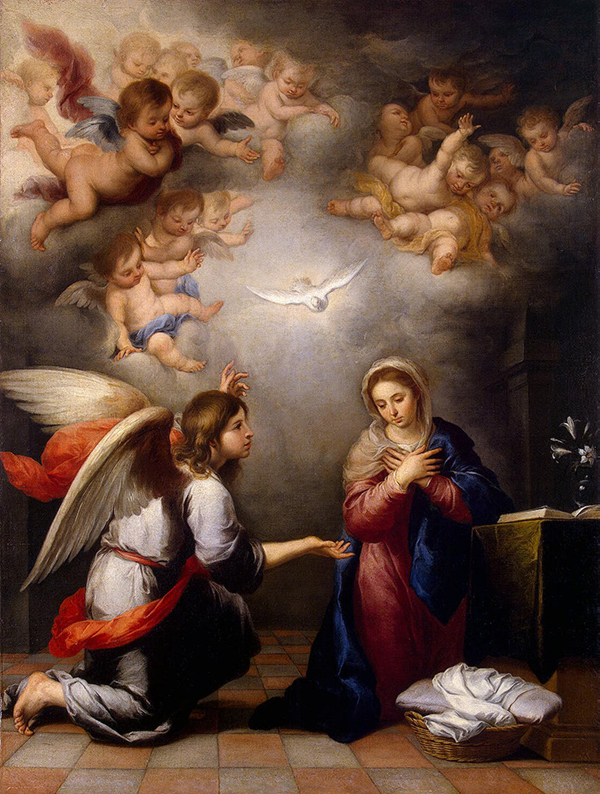
That’s because the Annunciation is the moment of the Incarnation. It is the turning point of salvation history, when the Creator of the universe entered His creation on a rescue mission to save us.
Light shines in the darkness
The Immaculate Conception preserved Mary from all stain of sin, thus making her a holy vessel for the incarnate God. Likewise, Mary’s Assumption into Heaven at the end of her life was God’s gift to her for her lifelong fidelity, especially her “yes” at the Annunciation. So the Immaculate Conception was preparation for the Annunciation, and the Assumption was the consequence of the Annunciation. Even Christ’s birth at Christmas was a result of the Annunciation.
The centrality of this moment in salvation history is reflected in the development of the Church’s liturgical calendar. Many assume that Christmas was fixed first and that the Annunciation was determined by counting backward nine months. In fact, it is widely believed that the Annunciation was calculated first.
The Gospel of Luke tells us that Elizabeth conceived when Zechariah was serving in the Temple — possibly on the Jewish Day of Atonement in late September. Since Elizabeth was in her sixth month when Mary conceived her Son, the Annunciation would therefore fall at the end of March.
Another theory links Christ’s conception with the creation of the world, the fall of Adam, and Christ’s Resurrection — all at the time of year when the earth becomes “new,” i.e., the Spring Equinox.
Either way, from the Annunciation on or around March 25, we add nine months and arrive at Christmas. Thus, both theologically and historically, the Annunciation stands as the pivotal historical moment. How fitting, then, that our calendars number the years from this event.
Mary’s home, and God’s
The Annunciation holds personal significance for me because of where it occurred: The home of the Blessed Virgin Mary. Tradition and thorough archeological study reveal that Mary’s home in Nazareth was a modest dwelling consisting of a three-walled structure joined to a cave. While the cave is revered to this day as the location of the Annunciation, the adjoining structure is no longer in Nazareth. In the 13th century, when Muslim were destroying several Christian sites, the Holy House was transported — according to pious tradition, by angels — to the town of Loreto, Italy. Today it is known as the Holy House of Loreto. It is enclosed in a beautiful basilica and is one of the most popular pilgrimage spots in Italy.
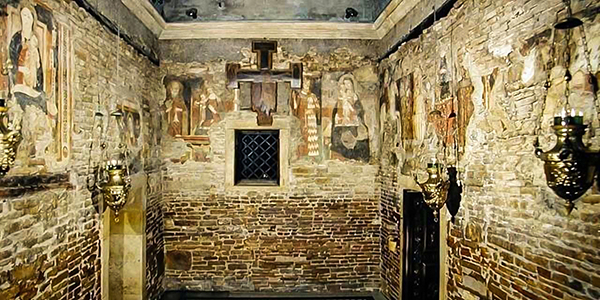
I was blessed to visit the Holy House in 2002 while discerning my vocation to the priesthood. Though I sensed God’s call years earlier, I feared a life of loneliness.
While praying the Rosary there on April 2, 2002, I experienced the closeness of the Blessed Mother in a powerful way and realized that I am never alone — that our Lord and Our Lady are closer to us than we are to one another on earth. That experience gave me the courage to embrace my vocation, and I eventually found the Marians of the Immaculate Conception.
In a real sense, I can say that I owe my vocation to Our Lady and the House where the Annunciation occurred.
On the Solemnity of the Annunciation, I encourage you ask the Lord for the grace to make a fuller “yes” to His will in your life and to pray the Rosary, followed by the Litany of Loreto. At some point in your life, if you have the means, I also encourage you to make a pilgrimage to the Holy House of Loreto and to pray in the place where the Word became Flesh in the womb of Our Blessed Mother.
God bless you!